
Cary Previous Residents by Era
An address trail changes with its era. A present parcel points to the county assessment and the most recent recorded instrument. Earlier ownership follows the deed chain and its legal description. Older named occupants may turn up in address directories, newspapers, or census schedules. In Cary, the right source can also depend on whether the parcel is in Wake, Chatham, or Durham County. Confirm that county on the Town map before treating a Wake result as the complete history.
| Source | Years It Covers | Where Held | What It Shows |
|---|---|---|---|
| Wake ROD legacy recorded documents | July 1785–April 17, 2025 | Wake Register of Deeds legacy index | deeds, liens, plats, maps, releases, parties and legal descriptions |
| Wake Records Management | launched April 21, 2025 | Wake Register of Deeds new application | post-migration recorded documents |
| Wake official plats | 1885–1950; index to 1981 | Olivia Raney and State Archives microfilm | subdivision, lot, block, and prior parcel layout |
| Hill's Raleigh directories | selected years 1933–55 | NCGenWeb and local-history collections | named address leads; Cary inclusion varies by volume |
| The Cary News | 1967–71 and 1974–2001 | NC Archives and library microfilm | obituaries, notices, social and property-related events |
| Cary permit data | since 2009 | Town of Cary | applications, work details and inspection chronology |
| Wake older permit search | before July 1, 2018 | Wake County | applicant, permit number, owner, address and PIN |
| Federal census | through 1950 under the 72-year release rule | NARA and library databases | household snapshot at enumeration |
Begin with the source closest to the period in question. Use the Wake online systems and Register of Deeds counter for a Wake-side parcel. Use the appropriate Chatham or Durham tax and recording offices for a parcel there. For older Cary address material, the practical fallback is the Olivia Raney reference collection, State Archives microfilm, and a staff-assisted catalog search rather than a broad web name search.
Note: A source can establish an owner, a listed address, a public notice, or a census household, but no single source proves the entire address history.
Cary Previous Residents and Deed Handoff
Wake's April 2025 system change is important for Cary address history. The legacy Consolidated Real Property Index expressly covers recorded documents from July 1785 through April 17, 2025. Wake launched its new Records Management application on April 21, 2025. The cutoff identifies which application to inspect. It does not mean a record created near the transition is absent. Search both systems and use the Register of Deeds counter if the chain needs a transition-date instrument or a clearer image.
Wake's Document Recording Alert form permits individual or business monitoring and encourages researchers to include name variations, initials, and full middle names. It is a current recording-alert tool, not a database of past residents. After the platform change, current alerts required re-registration. Its value here is as a reminder that deeds may be indexed under a short form, a middle initial, an entity, or another name variation.
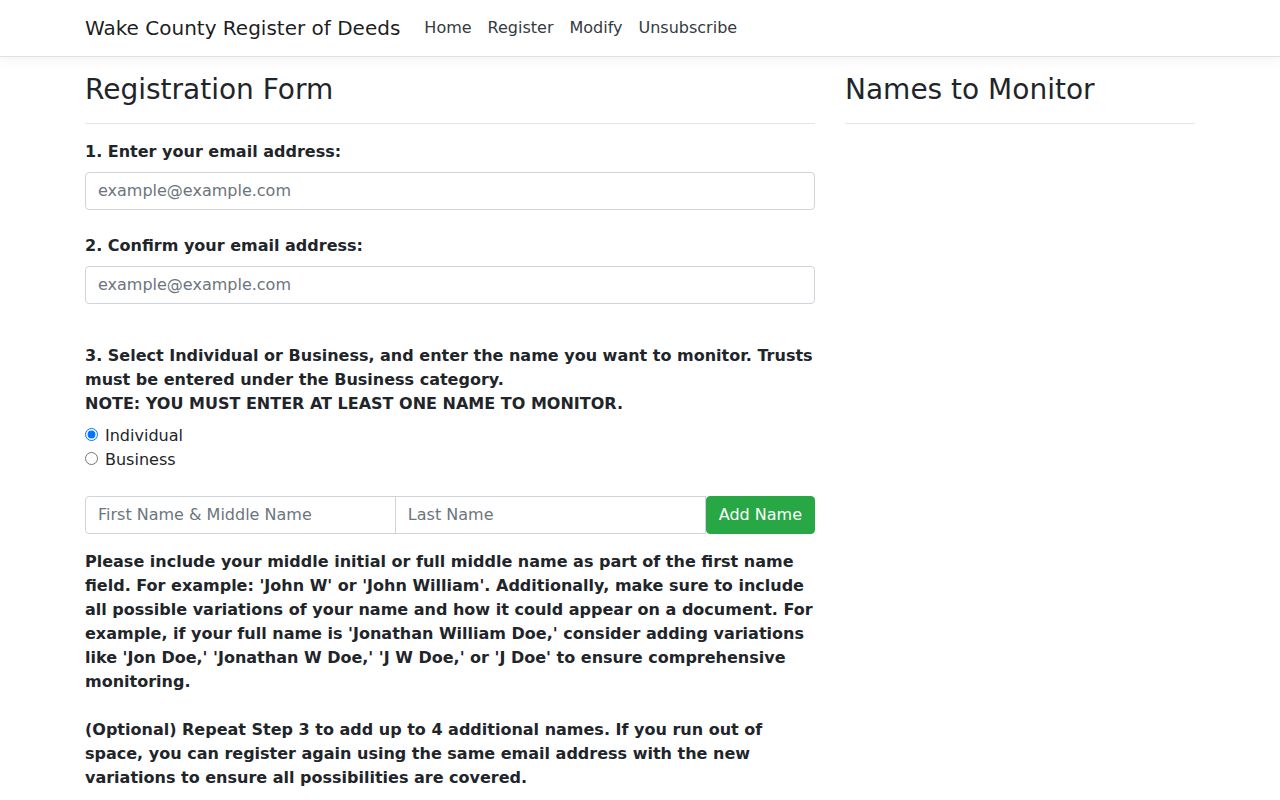
Use name variations in the deed index, then read the recorded image before assigning a person a role in the Cary address trail.
Cary Address Records Start with PINs
The most dependable starting point is the current parcel. For most Cary property, Wake Real Estate Search accepts owner fields, a street number and street name without the street type, Real Estate ID, or a PIN route with map, scale, block, and lot. Save the current owner of record, situs address, mailing field, Real Estate ID, PIN, legal description, and deed or sales reference. The mailing field may be a different location or an entity contact, so it is not a statement about who lived at the Cary address.
A useful address-history flow is simple: current street address → parcel PIN and legal description → most recent deed → prior deed reference → older plat or directory. The Cary Property Research Map adds parcel boundaries, town limits, ETJ, ZIP, annexation, and plat context. It helps route an edge parcel to Wake, Chatham, or Durham before the backward chain begins.
Cary Address Records Bridge Old Tracts
Street numbers are a recent convenience, not the lasting land identifier. A deed may identify a lot and block, subdivision, metes-and-bounds tract, farm name, railroad reference, or map book and page instead. Cary's rapid change from the original Page development through postwar annexations and later growth in Carpenter and Green Level makes this especially important. The legal description can stay recognizable even while the road name, postal label, development, or municipal context shifts.
Wake official plat holdings offer a concrete bridge: 1885–1950 map microfilm and a plat index to 1981 are held through local-history and archive channels. When the current address is missing from an old deed, compare the parcel's legal description to the plat, subdivision, lot, or block. Then search the map or book reference in the county records. Cary's map can supply a lead, but the Register of Deeds controls the recorded plat, survey, covenant, and deed.
Trace Cary Previous Residents Through Deeds
The recorded chain begins with a current assessment record but proceeds through deeds. In Wake, open the newest instrument by the current owner, grantor or grantee name, date range, document type, or book and page. Read the instrument itself for the parties, execution and recording dates, legal description, map references, return address, and earlier document references. An instrument can be held by an estate, trust, entity, or trustee, so identify the role shown rather than assuming a household connection.
- Copy the current Cary parcel's PIN, legal description, owner of record, and the newest deed reference from the county property record.
- Find that deed in the Wake legacy deed index, or in the new Wake records application when the recording falls after the migration.
- Read the current purchase deed. The buyer is the grantee and the seller is the grantor. Capture the prior instrument, subdivision, lot or block, and map references.
- Search the seller as grantee in an earlier period to locate that seller's own purchase. Repeat the process with spelling variants, initials, suffixes, and entity names.
- Move to the Register of Deeds counter, deed books, plat microfilm, or archive materials when the online result ends or the legal description becomes the more reliable key.
- Grantor / grantee
- The grantor transfers an interest in the instrument. The grantee receives it. The names identify roles in a transaction, not necessarily a current address.
- Chain of title
- The linked sequence of recorded transfers for the same parcel or legal description.
- Legal description
- The land description in the recorded document, such as a lot and block or metes and bounds. It outlasts a changed street number.
- Criss-cross directory
- An address-first directory that can put a named person at an address for one publication period.
Cary Address Records Date Changes
Permits can bracket physical change at a Cary address. The Town's reports and records service provides permit data since 2009, including applications and inspections. Its address and permit-number routes can show work chronology, project description, application roles, issue or status, and inspection events. For older material, the Wake permit database has records before July 1, 2018 and allows applicant, permit number, owner, address, and PIN searching.
If the online tables do not answer the question, Cary's Inspections and Permits Department accepts counter, phone, and email requests. A specific Chapter 132 request should identify the address, time period, permit type, and records wanted. A permit helps date a build, remodel, or inspection. It does not place every past resident at the address, and an applicant or contractor can be different from the owner shown on the parcel.
Cary Previous Residents in Directories
Deeds establish a property trail, while historical directories and census schedules can supply a household layer. Cary has no verified continuous city-directory series, so regional Raleigh and suburban volumes must be checked one by one. The Olivia Raney catalog identifies Raleigh City Directory holdings, while NCGenWeb names selected Hill's Raleigh years from 1933 through 1955. A volume may include Cary, a suburban route, or no relevant entry. Read it as a dated address lead, not a complete population record.
Pair one directory year with the nearest available federal census year. Federal population schedules through 1950 are generally available under the 72-year release rule, but Cary may appear as a town, township, rural Wake area, or a place with changing boundaries. Search surname variants, nearby households, the county, and the old community name when the current address does not fit the historical schedule.
- Start with the directory's alphabetical or street section and record the exact spelling, address form, household notation, and page.
- Compare that year with the closest census schedule, using county and township context before assuming the modern Cary boundary.
- Test the result against the deed date and legal description, then use a newspaper notice, cemetery source, or probate file to close an uncertain interval.
Lawful use. Cary house and family history research should remain personal and respectful. Do not use records to stalk, harass, track, intimidate, or harm any living person.
Cary Address Records Close Newspaper Gaps
The Cary News offers a dated local source between deed events. The NC Archives guide preserves 73 reels covering 1967–1971 and 1974–2001. The visible 1972–1973 gap matters. Search that period in Raleigh papers instead of silently filling it with an assumed Cary result. Notices can supply a name variation, former address, death notice, community activity, or a date to test against the deed and directory trail.
The official NC Archives newspaper guide and the Olivia Raney reference desk are the access routes for this work. Obituaries and probate records provide endpoints, not automatic proof of a full address history. For estate files, the Wake Clerk of Superior Court holds the official probate file; earlier and non-Wake research follows the county that had jurisdiction.
Note: A newspaper notice is strongest when its date, place, and named relationship agree with the recorded parcel and directory evidence.
Cary Address Records Change Context
Cary began around Frank Page's 1854 land acquisition and incorporated in 1871. Its railroad-linked original town was later joined by postwar growth, annexations, subdivisions, and expanded western communities. That history can leave one property described by a rural route, community name, former road, lot, subdivision, or modern street address at different points in the record trail. Green Level and Carpenter are especially useful reminders to search community and road names alongside the present address.
For an unresolved old address, use the Cary map, county plat and deed records, local-history microfilm, and the State Archives finding aids together. Mark the source date and custodian in your notes. A missing online match can reflect indexing, a platform split, a different county, or a change in address language. It is not proof that the past household or property record never existed.