
Begin a Cary Resident Search
Cary has no single official list of every household. A current property record is useful when the question starts with an address or owner. A named person may be confirmed through the NCSBE voter search, a court index, or a recorded instrument, depending on the public record involved. Each source proves a limited fact. An assessment result identifies the owner of record, while a voter result reflects registration rather than every person in a household.
Start narrowly and save the identifiers that make the next search reliable. For a parcel, keep the PIN, Real Estate ID, legal description, and deed reference. For a name, preserve spelling variants, the filing county, and a date range. When an online result is incomplete, the clerk, Register of Deeds, library, or State Archives can supply the next access channel.
- Use the parcel map and county route to establish where the Cary address sits.
- Search the responsible property system by address, owner name, Real Estate ID, or PIN.
- Read the deed index for recorded parties, document date, and legal description.
- Confirm a registration or public court result only when the name and county fit.
- Use local-history shelves, microfilm, or a focused records request for older material.
Cary Offices Behind Resident Records
Most Cary research starts in Wake County, but a parcel in the Chatham or Durham portion of town must be handled by that county's tax, deed, court, and election offices. The Town of Cary Property Research Map helps sort out the parcel and boundary before a search begins. Wake County keeps the dominant set of local assessment and recorded-land records, while statewide offices supply voter, court, vital-record, and archive routes.
Wake County Register of Deeds
Justice Center, 300 S. Salisbury Street, Suite 1700
Raleigh, NC 27601
919-856-5460
Wake County Real Estate Search
Wake County assessment and tax records
Raleigh, NC
Confirm office service before travel
North Carolina State Board of Elections
Statewide voter registration lookup
County selection includes Wake, Chatham, and Durham
Protected-address rules apply
The Cary street directory follows the address-based chain in detail, including parcel and map research along a named street.
Cary's Three-County Address Route
A Cary mailing address does not settle the question of custody. Town limits include Wake, Chatham, and Durham Counties, and the parcel's county controls the tax record, land records, election registration route, court counter, and many local vital-record services. The Town map distinguishes county boundaries, ZIPs, town limits, ETJ, utility boundaries, parcels, zoning, and recorded plats. Check that geography before treating a Wake search as conclusive.
The Town of Cary Property Research Map is an orientation tool rather than proof of title. Its REST property service offers Property and Town Owned Property layers plus Identify and Query operations. A clicked parcel should then be checked in the appropriate county property system and, for ownership history, in that county's recorded documents.
Cary's property-layer service shows the map layers used to place a parcel in context.
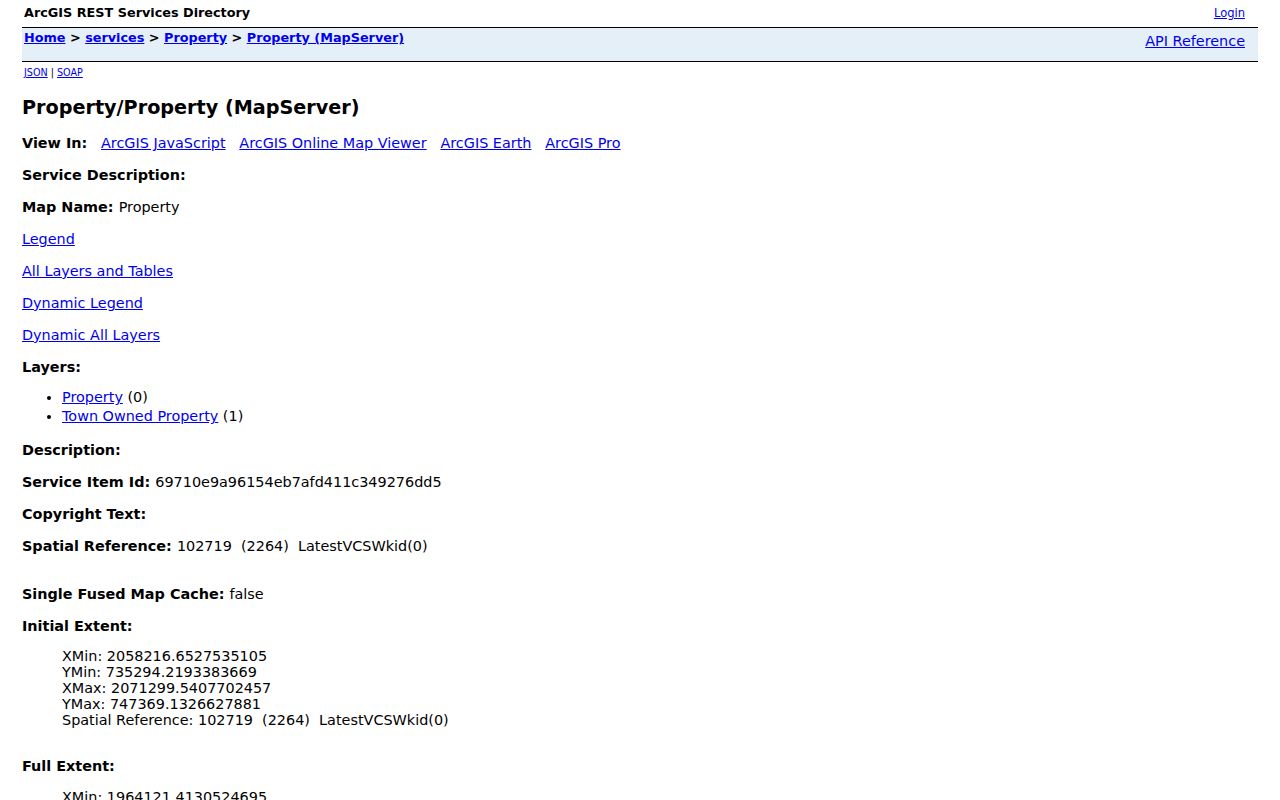
The image is a reminder that map shapes and boundary layers are a starting point. The deed, tax office, or survey remains the record to verify when ownership or legal boundaries matter.
Search Wake Parcels by Cary Address
For most Cary parcels, Wake Real Estate Search is the practical first stop. Its owner route accepts last name, with first, middle, and business-owner fields available. The address route uses street number and street name, and Wake instructs searchers to omit the street type. A partial street can produce a refinement list. Real Estate ID and the PIN route offer other ways to find the parcel.
| Wake search field | Use | Format note |
|---|---|---|
| Owner name | Find an owner of record | Last name leads an individual search |
| Location address | Find a Cary parcel | Enter number and street name, omit street type |
| Real Estate ID | Open a known tax record | Wake example uses 0185211 |
| PIN | Match a parcel identifier | Map, scale, block, and lot form the alternate route |
Wake Real Estate Search displays the owner of record, property or situs address, mailing address, assessment, legal description, tax-bill link, and sales or deed references. A situs address is the physical parcel. A mailing address is where the tax notice goes, and can be an office, P.O. box, trustee, or address outside Cary. Neither field is a complete household list.
The Wake property search interface is shown in the official-source capture below.
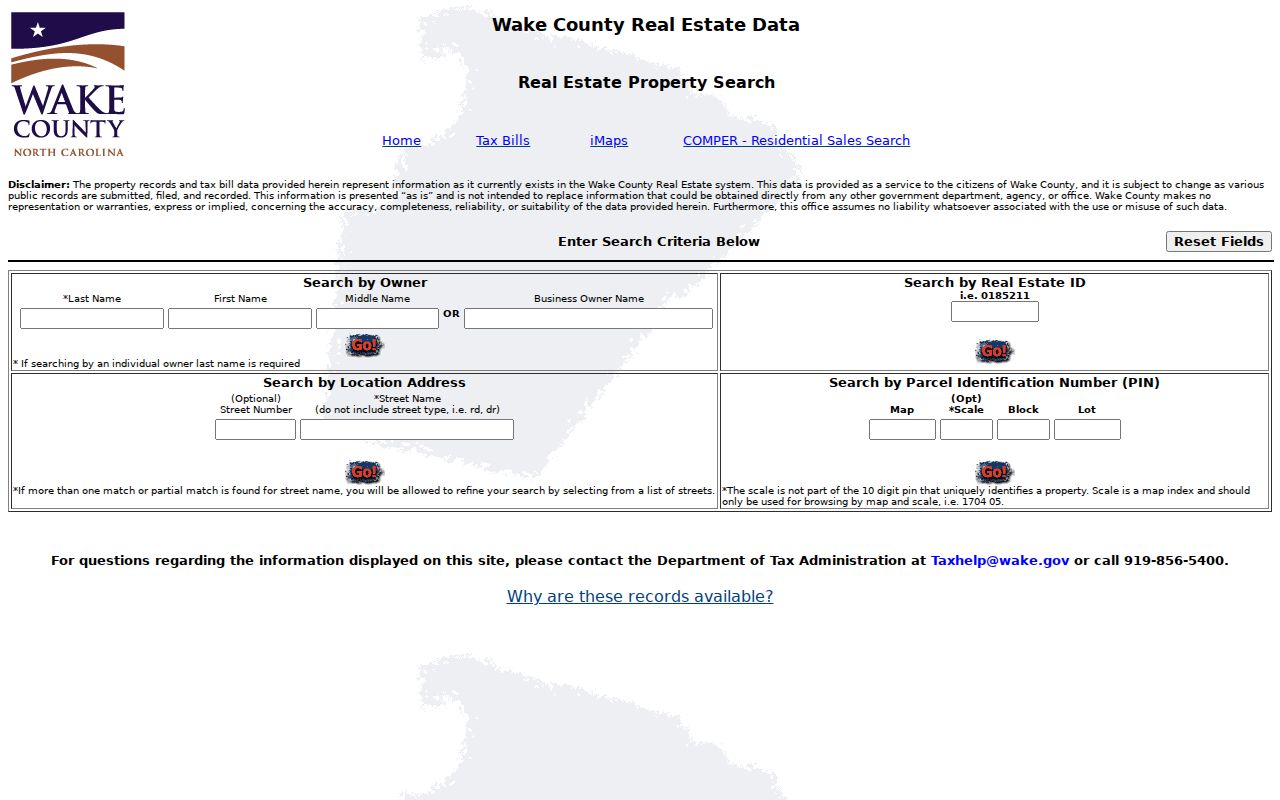
Keep the PIN and deed reference from a result. They provide the bridge from an assessment card to a recorded instrument and help separate similar addresses.
Wake Deeds Add a Cary Record Trail
The Wake Consolidated Real Property Index is a catalog-like guide to recorded documents, not a substitute for the instrument itself. Its legacy application covers recorded documents from July 1785 through April 17, 2025. Search by grantor or grantee, document type, date range, book, page, and Standard or Sounds Like name logic. The office recommends fewer characters and spelling variants when an expected name does not appear.
For instruments recorded after the migration, use the newer Wake Records Management application launched April 21, 2025. The short platform split should be checked on both systems instead of treated as a missing period. The underlying deed can identify the grantor, grantee, recording date, legal description, prior references, book or page, and the role of an individual or entity.
- Parcel
- A mapped piece of land identified in the assessment system, commonly with a PIN.
- Index
- A search aid that points to records. It is not the certified underlying document.
- Grantor and grantee
- The party conveying an interest and the party receiving it in a recorded instrument.
- Legal description
- The lot, block, subdivision, metes-and-bounds, or other land description used in a deed.
Cary Resident Directory Sources Today
Current directory-like sources answer different questions. A Cary residents directory search must separate those roles. The assessment roll ties an owner to a parcel. The voter search confirms a registration record when public. The recorded-land index identifies document parties. Cary's staff directory names Town employees, not town residents. No official source reviewed provides a complete public roster of Cary households.
| Source | What it can confirm | Keeper | Access route |
|---|---|---|---|
| Property assessment | Owner, parcel, situs, mailing and legal-description fields | Responsible county tax office | Portal or counter |
| Voter registration | Registered voter information subject to protections | NCSBE and county boards | Public search or lawful written request |
| Recorded land index | Parties to deeds, liens, maps, and other instruments | County Register of Deeds | Index, image, or counter |
| Cary staff directory | Town employee title and public contact details | Town of Cary | Free online directory |
Use the source that matches the fact you need. For a named individual, the Cary resident lookup applies a one-person verification sequence instead of assuming that one database settles identity.
Confirm Cary Voter Registration Carefully
NCSBE Voter Search takes first name, middle initial, last name, year of birth, county, and registration status. A public individual record can include name, address, age, gender, race, party affiliation, voting history, precinct, and districts. Search the county that actually holds the registration, not merely the postal city. The current registration-data files are another route where released fields and file layout support the question.
A voter record is not a household census. It does not list people who are not registered, and the physical address of a certified Address Confidentiality Program participant is protected. North Carolina's public-record rules also leave juvenile, sealed, expunged, adoption, medical, and other confidential material outside an ordinary public lookup.
Cary Name Checks Through NC eCourts
NC Judicial Branch eCourts is statewide, including Wake and the other counties that contain Cary. Smart Search lets a user narrow by location, party name, year of birth, case number, case type, case status, and filing-date range. Wildcard guidance requires at least three last-name characters plus an asterisk. Search Hearings and NC Judgment Search provide related public entry points.
Public results can show a party role, case number, case type, county, filing date, status, events, hearings, dispositions, public attorney data, and public documents. The portal is an access view, not the official court record. For a certified copy, older paper file, or a question about a restricted document, contact the Clerk of Superior Court for the filing county.
NC eCourts Portal is the official public starting point for this court search.
The portal screen helps identify a public docket, but a same-name match needs county, date, role, and other records before it can be treated as the right person.
Cary Vital Records Need a Request
NC Vital Records is not a free name-search database. The state holds births from 1913, deaths from 1930, marriages from 1962, and divorces from 1958, while older material routes to county offices, the Clerk, or State Archives. For a Wake event, Wake Register of Deeds can issue Wake birth, death, and marriage copies. The filing county controls the local route when an event occurred in the Chatham or Durham part of Cary.
Certified access is governed by eligibility and identity rules. The state order route lists a $24 first search or certificate fee and $15 additional certificates, plus processing. Wake's county application lists $10 per certified birth, death, or marriage copy for eligible Wake records. A marriage certificate is not a divorce decree, and a court file may contain restricted material.
North Carolina's certificate-order page explains the document and eligibility choices before an order is submitted.
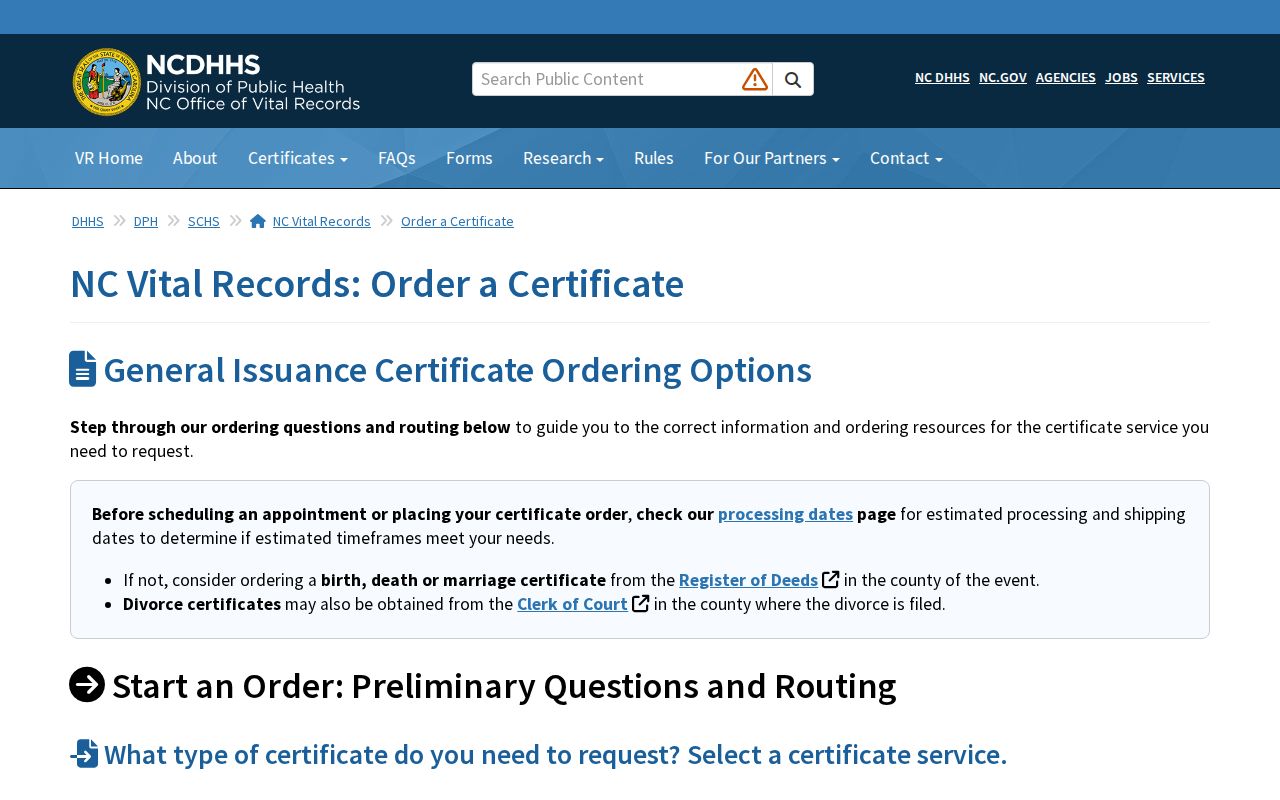
The order screen shows why an event date and county are useful, but it does not make protected birth or adoption information public.
Historical Cary Resident Directories
Cary's historical record shelf is regional rather than a single continuous city-directory run. An old Cary residents directory lead may instead sit in a Raleigh or suburban volume. Olivia Raney Local History Library holds reference and consult-staff materials, including Raleigh and suburban directories, newspapers, yearbooks, maps, and microfilm. NCGenWeb lists Hill's Raleigh directory years from 1933 through 1955 in selected runs, and a 1939 News & Observer Raleigh Directory is another lead. Cary inclusion must be confirmed volume by volume.
The Cary News survives on 73 reels for 1967 through 1971 and 1974 through 2001, with a visible two-year gap. Cary High yearbooks at Olivia Raney supply selected years from 1920 through 2020. These sources can place a household in an era but should be paired with deeds, census schedules, cemetery records, or probate where identity matters. The Cary city directory page details the available collections and how to read them.
Cary's 2025 Records Platform Shift
Cary land research changed in April 2025 because Wake County moved its recording system. The Cary researcher who needs a recent deed should use the legacy index through April 17 and the new Records Management application after the April 21 launch. A document near the cutover needs a search in both Cary-facing Wake systems and, if necessary, a call or visit to the Wake Register of Deeds counter. That is a platform handoff, not a four-day loss of Cary instruments.
Cary court research also changed when eCourts reached all North Carolina counties in October 2025. A Cary result may show a converted event time that looks unusual, including a midnight timestamp on older Odyssey-converted entries. Compare the case number, county, and document date, then ask the Cary-area filing clerk for an official record if the portal display does not answer the question. Date discipline is especially important when a Cary property, court, or permit record crosses a technology change.
Cary History Fills Record Gaps
Cary began with the Page family's 1854 development and incorporated in 1871, but present-day Cary includes much later annexations, subdivisions, and communities. Downtown Cary, Green Level, Carpenter, Russell Hills, Montclair, and MacGregor Downs can use different road names, lot descriptions, and historical sources. A Cary address in a recent western development may need a plat and parcel record. A Cary household in an older crossroads area may appear first in a newspaper, church, cemetery, directory, or rural Wake record.
For Cary family-history work, Olivia Raney staff can help connect Cary directories, Wake deed microfilm, official plats, Cary News reels, and selected Cary High yearbooks. State Archives finding aids provide another Cary fallback for county court, probate, military, naturalization, and family records. The right Cary source depends on when the record was created, who kept it, and whether the source names an owner, an occupant, a public participant, or a family connection.
When Cary Records Move Offline
North Carolina Public Records Act, N.C.G.S. Chapter 132, allows inspection or copies unless another law makes a record confidential. It does not set one universal response deadline. A focused request should identify the custodian, record type, date range, address or case number, preferred format, and the non-confidential portion requested. The custodian may charge reasonable search, redaction, or reproduction costs where the law allows.
Use the county Register of Deeds for recorded instruments, the county Clerk for court and estate files, the Town custodian for municipal records, and the State Archives or Olivia Raney staff for older holdings. Online absence can mean a platform change, a restricted record, a wrong county, a spelling difference, or a collection that remains on microfilm. It does not prove a record was never created.